


Editor's note: this interview was conducted in 2022 when Pitch was newly launched. The magazine has since gone on to publish 17 issues and continues to publish quarterly. We're currently sold out of Issue 1 and limited stock of Issue 2. Alongside these, we hold a good range of Pitch back issues, which you can browse here.
It's always exciting when a new magazine launches, but we were really impressed by the quality and range of Pitch. Celebrating modern sport in all its forms, Pitch is 132 pages of did-you-knows, bluffer's guides, behind-the-scenes stories, profiles and opinion pieces. It's a great read (for the fair-weather sports fans among us and for our sports fanatic in residence, Rob).
We sat down for a chat with editor Andy Afford.
Congrats on the first issue. Apart from the print edition of Slowe Journal a few years ago, we haven't come across any other magazines celebrating sport in all its many forms. How did the idea come about and what was your goal for the magazine?
Andy: Thank you, we are pleased with it. As you've spotted, sports titles tend to be the preserve of the specialist. But we felt that we knew so many more people that were actually pretty generalist, as sports fans, and in their sporting likes and tastes.
We've built Pitch around the "major food groups" of football, rugby and cricket, plus broadly whatever sits at the top of the BBC Sport website. We thought that if we could find stories interesting or entertaining enough, people would enjoy reading in a bit more depth about the stuff on the periphery of what they usually went for. And judging by the reaction, we've been right.
It's a bit too well-made, well-designed and well-paced for a first issue. We're guessing you've been in magazines for a while?
Andy: Again, that's very kind of you to say. I've worked in the industry for a good while, sport and music mainly, but Kevin Whitchurch, our publisher, is a different beast altogether. His involvement in print, some people believe, pre-dates Caxton's.

William Caxton (printing press entrepreneur circa 1476)
We're always curious about how magazines get made. What kind of team do you have working on Pitch?
Andy: I'd say we've a decent-sized team in-house. As stated, Kevin is incredibly well connected in terms of pulling in freelance writing support, and we've been able to handle the design stuff pretty successfully across the team. As a business, we try to mix some old lag-ery at the top of the masthead with as young and as broad a creative team as we can. It's what we think gives the title its energy, its modernity and, in essence, a reason for it to exist.
How would you describe Pitch? What can readers expect?
Andy: I'd like to think it's a broad sports-based read that's a perfect mix of entertainment and information. We've certainly tried to fill it with as many "did you know" moments as we can, because we know that magazine readers love all that stuff. There's nothing better than knowing something your mates don't, is there? Especially about sport. And there feels like there are hundreds of them in the first issue alone.

Brush up on your baseball with Pitch's 100 facts about America's national pastime.
Who do you think will enjoy reading Pitch?
Andy: I heard the title described as serious without taking itself too seriously. It can be enjoyed as a broad accompaniment to the sporting calendar, as equally as it can be enjoyed feature by feature. It's for the same people that like books, podcasts, vinyl, jeans and repeat buy the exact same pair of work boots.

Impress down the pub with The Bluffer's Guide to The Open at St. Andrews
What other indie magazines are you reading at the moment?
Andy: I've always been a massive fan of the music monthlies. It's a curse really, but I love them. Mark Ellen and David Hepworth are gods of the genre. I'd love to do a music version of Pitch. Creative Director Sam Bowles is a massive fan of the likes of Monocle and all of the titles of that sort of ilk. Those that can be harshly categorised, by me, as being to be looked at and not needing to be read. But that's designers for you, isn't it.
And finally, in the increasingly online world, why is print still important?
Andy: I think editorially-led design (from a creative agency like ours' perspective) is a money-where-its-mouth-is kinda thing. I think it's still the most advanced lifeform, in terms of marcomms. The easiest to do badly. And the most challenging to deliver brilliantly. That's why it's exciting. It's, in essence, a 132-pages-words-picture-fun-and-fact mark of how good you are at communicating, as a creative force. And there's nothing like the smell either.
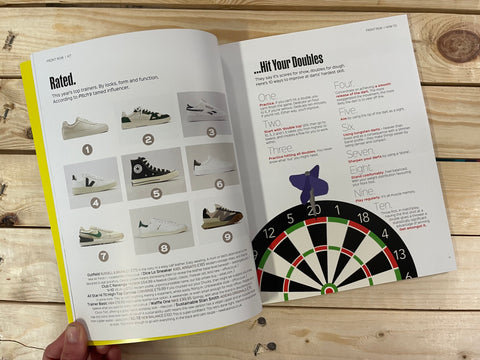
Issue 1 has tips to help dust off your dart skills
Thank you, Andy. You can browse our current stock of Pitch here!
1 comment
xxx